Fresh Summer Truffles
Tuber aestivum — the most widely distributed of the valued truffle species, found across southern and central Europe, parts of the UK, and as far east as Russia and China. These are sourced from Italy, where the combination of calcareous soils, oak and hazel woodland, and warm summers produces reliable fruiting from May through August.
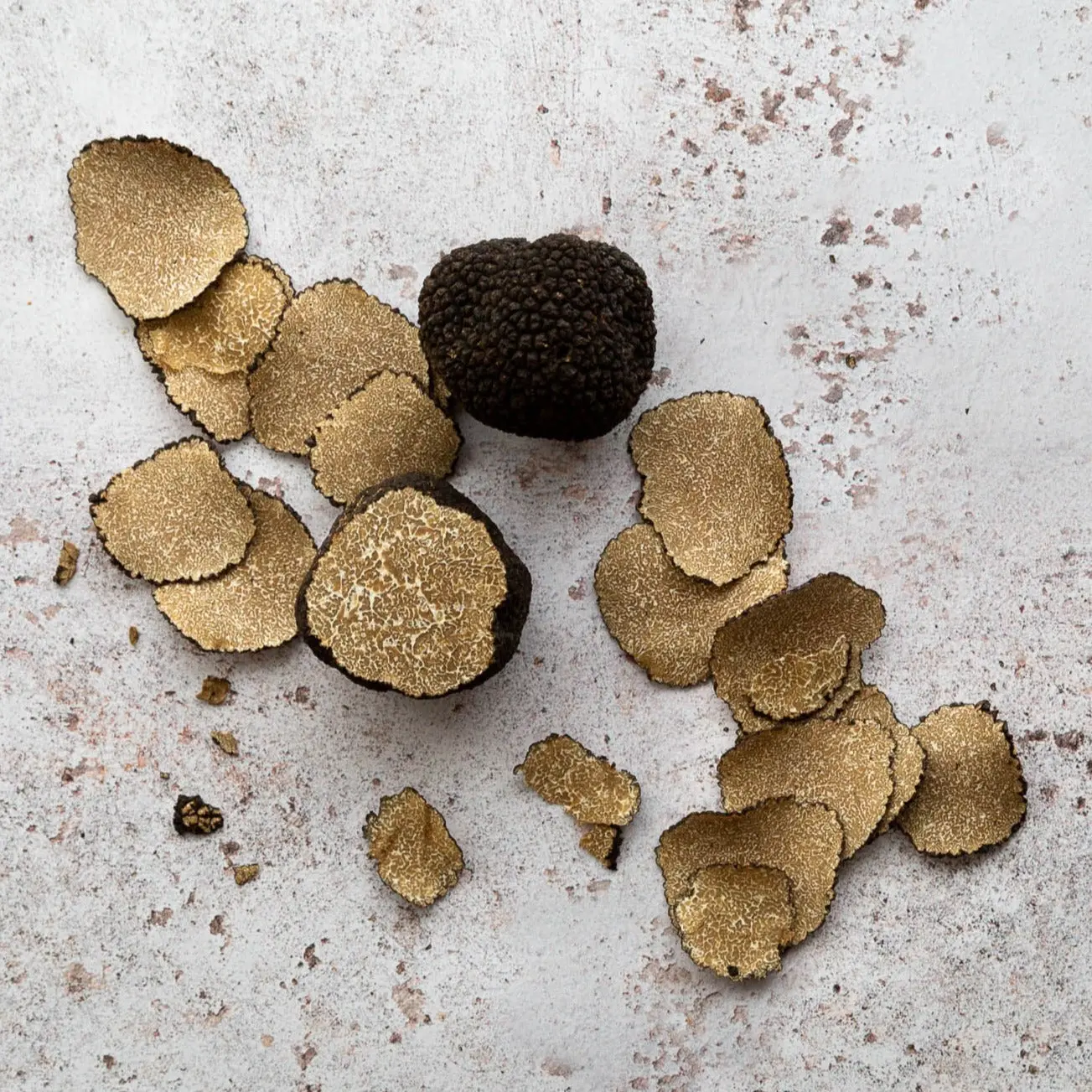
Summer truffles are often dismissed as a lesser product compared to the winter black truffle (Tuber melanosporum) or the white Alba truffle (Tuber magnatum), and it is true that their aroma is more restrained. But that misses the point — the flavour profile is different rather than simply weaker. Where winter truffles are pungent and musky, summer truffles offer something more delicate: notes of caramel, hazelnut, and vanilla, with a gently earthy, oaky undertone. The interior flesh (gleba) is pale — cream to light brown with fine white marbling — which visually sets it apart from the dark, heavily veined interior of a winter Périgord.
The outer skin (peridium) is rough, dark brown to black, and covered in small, pyramidal warts. It is noticeably tougher than the interior and can carry a bitterness that detracts from the more delicate flavour of the flesh inside. For this reason, it is worth gently scraping or paring away the peridium before use — a small knife is all you need — to expose the paler, more aromatic core.
Fresh truffle is a perishable product. The aromatic compounds — primarily dimethyl sulphide and various alcohols and aldehydes — are volatile and begin to diminish from the moment the truffle is unearthed. Use as soon as possible after delivery for the fullest experience.
Origin: Italy.
Ingredients: Fresh summer truffles (Tuber aestivum).
Tuber aestivum — the most widely distributed of the valued truffle species, found across southern and central Europe, parts of the UK, and as far east as Russia and China. These are sourced from Italy, where the combination of calcareous soils, oak and hazel woodland, and warm summers produces reliable fruiting from May through August.
Summer truffles are often dismissed as a lesser product compared to the winter black truffle (Tuber melanosporum) or the white Alba truffle (Tuber magnatum), and it is true that their aroma is more restrained. But that misses the point — the flavour profile is different rather than simply weaker. Where winter truffles are pungent and musky, summer truffles offer something more delicate: notes of caramel, hazelnut, and vanilla, with a gently earthy, oaky undertone. The interior flesh (gleba) is pale — cream to light brown with fine white marbling — which visually sets it apart from the dark, heavily veined interior of a winter Périgord.
The outer skin (peridium) is rough, dark brown to black, and covered in small, pyramidal warts. It is noticeably tougher than the interior and can carry a bitterness that detracts from the more delicate flavour of the flesh inside. For this reason, it is worth gently scraping or paring away the peridium before use — a small knife is all you need — to expose the paler, more aromatic core.
Fresh truffle is a perishable product. The aromatic compounds — primarily dimethyl sulphide and various alcohols and aldehydes — are volatile and begin to diminish from the moment the truffle is unearthed. Use as soon as possible after delivery for the fullest experience.
Origin: Italy.
Ingredients: Fresh summer truffles (Tuber aestivum).
Description
Tuber aestivum — the most widely distributed of the valued truffle species, found across southern and central Europe, parts of the UK, and as far east as Russia and China. These are sourced from Italy, where the combination of calcareous soils, oak and hazel woodland, and warm summers produces reliable fruiting from May through August.
Summer truffles are often dismissed as a lesser product compared to the winter black truffle (Tuber melanosporum) or the white Alba truffle (Tuber magnatum), and it is true that their aroma is more restrained. But that misses the point — the flavour profile is different rather than simply weaker. Where winter truffles are pungent and musky, summer truffles offer something more delicate: notes of caramel, hazelnut, and vanilla, with a gently earthy, oaky undertone. The interior flesh (gleba) is pale — cream to light brown with fine white marbling — which visually sets it apart from the dark, heavily veined interior of a winter Périgord.
The outer skin (peridium) is rough, dark brown to black, and covered in small, pyramidal warts. It is noticeably tougher than the interior and can carry a bitterness that detracts from the more delicate flavour of the flesh inside. For this reason, it is worth gently scraping or paring away the peridium before use — a small knife is all you need — to expose the paler, more aromatic core.
Fresh truffle is a perishable product. The aromatic compounds — primarily dimethyl sulphide and various alcohols and aldehydes — are volatile and begin to diminish from the moment the truffle is unearthed. Use as soon as possible after delivery for the fullest experience.
Origin: Italy.
Ingredients: Fresh summer truffles (Tuber aestivum).