Fresh Lobster Mushrooms
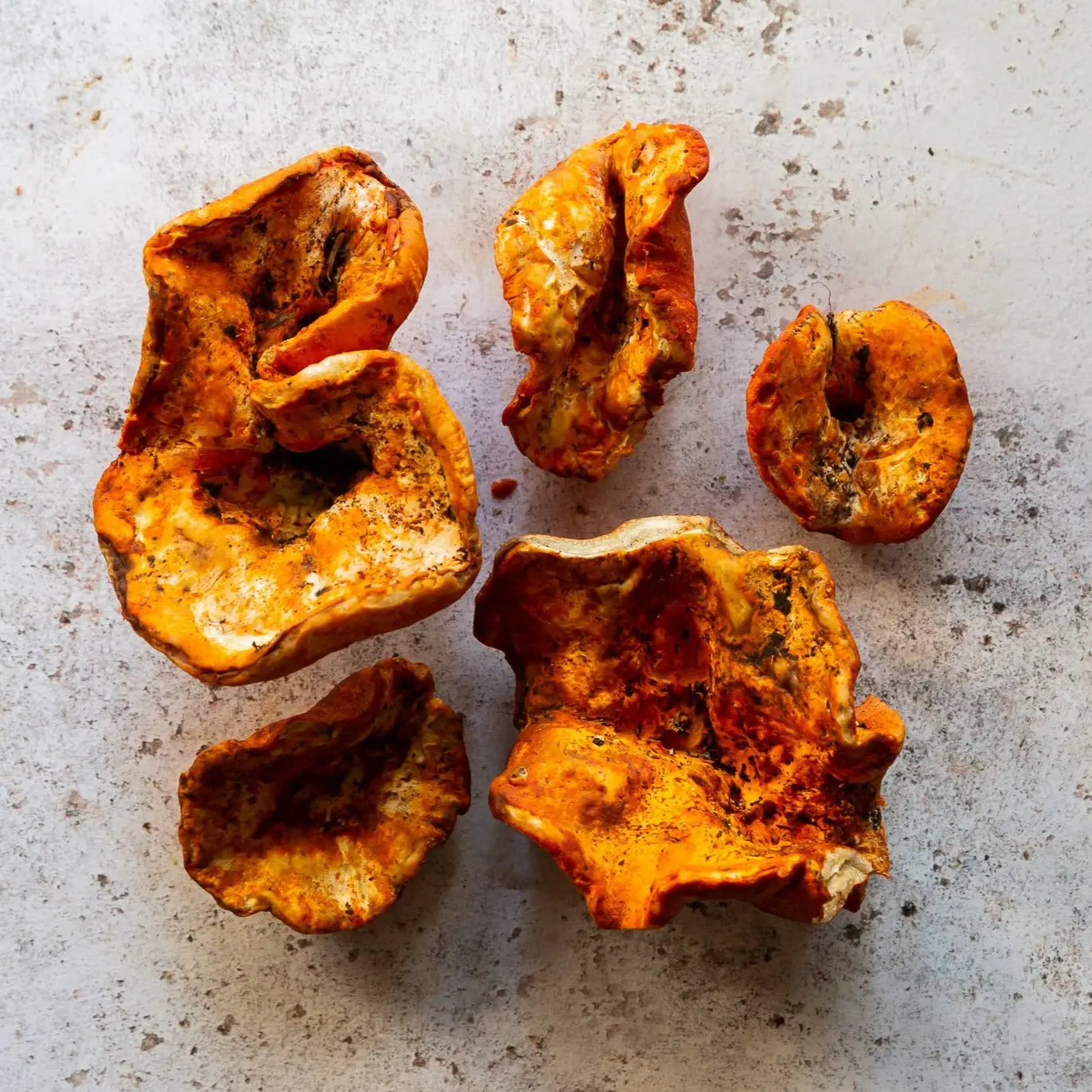
The lobster mushroom is not a species of mushroom. It is the result of a parasitic fungus — Hypomyces lactifluorum — colonising a host mushroom, usually a Russula or Lactarius species. The parasite envelops the host entirely, transforming its appearance, texture, and flavour into something unrecognisable from the original. The outer surface turns a vivid orange-red — the colour that gives it its common name — while the interior flesh becomes dense, white, and firm. The host mushroom, which would typically be brittle and unremarkable, is completely overtaken.
What makes this biologically unusual is that the parasite improves the host. The Russula and Lactarius species that Hypomyces lactifluorum typically attacks are either bland or mildly unpleasant to eat on their own. The parasitic transformation produces a mushroom with a firm, meaty texture, a subtly nutty flavour, and a faint seafood-like aroma that is the reason for the lobster comparison. The red-orange pigment on the surface is water-soluble and will bleed when cooked — in a risotto or a cream sauce, it tints everything it touches a pale coral, which is visually striking.
These are wild-foraged in North America, where the Hypomyces parasite is most commonly found on forest floor mushrooms in the Pacific Northwest and northeastern hardwood forests. They cannot be cultivated — the parasitic relationship requires specific wild host mushrooms in their natural habitat — which limits supply to a short autumn window.
Clean by dry brushing rather than washing, as water removes the distinctive surface colour. The flesh is firm enough to slice into thick steaks or dice into chunks that hold their shape through cooking.
Origin: USA (wild foraged)
Ingredients: Lobster mushroom (Hypomyces lactifluorum).
The lobster mushroom is not a species of mushroom. It is the result of a parasitic fungus — Hypomyces lactifluorum — colonising a host mushroom, usually a Russula or Lactarius species. The parasite envelops the host entirely, transforming its appearance, texture, and flavour into something unrecognisable from the original. The outer surface turns a vivid orange-red — the colour that gives it its common name — while the interior flesh becomes dense, white, and firm. The host mushroom, which would typically be brittle and unremarkable, is completely overtaken.
What makes this biologically unusual is that the parasite improves the host. The Russula and Lactarius species that Hypomyces lactifluorum typically attacks are either bland or mildly unpleasant to eat on their own. The parasitic transformation produces a mushroom with a firm, meaty texture, a subtly nutty flavour, and a faint seafood-like aroma that is the reason for the lobster comparison. The red-orange pigment on the surface is water-soluble and will bleed when cooked — in a risotto or a cream sauce, it tints everything it touches a pale coral, which is visually striking.
These are wild-foraged in North America, where the Hypomyces parasite is most commonly found on forest floor mushrooms in the Pacific Northwest and northeastern hardwood forests. They cannot be cultivated — the parasitic relationship requires specific wild host mushrooms in their natural habitat — which limits supply to a short autumn window.
Clean by dry brushing rather than washing, as water removes the distinctive surface colour. The flesh is firm enough to slice into thick steaks or dice into chunks that hold their shape through cooking.
Origin: USA (wild foraged)
Ingredients: Lobster mushroom (Hypomyces lactifluorum).
Original: $33.84
-70%$33.84
$10.15Description
The lobster mushroom is not a species of mushroom. It is the result of a parasitic fungus — Hypomyces lactifluorum — colonising a host mushroom, usually a Russula or Lactarius species. The parasite envelops the host entirely, transforming its appearance, texture, and flavour into something unrecognisable from the original. The outer surface turns a vivid orange-red — the colour that gives it its common name — while the interior flesh becomes dense, white, and firm. The host mushroom, which would typically be brittle and unremarkable, is completely overtaken.
What makes this biologically unusual is that the parasite improves the host. The Russula and Lactarius species that Hypomyces lactifluorum typically attacks are either bland or mildly unpleasant to eat on their own. The parasitic transformation produces a mushroom with a firm, meaty texture, a subtly nutty flavour, and a faint seafood-like aroma that is the reason for the lobster comparison. The red-orange pigment on the surface is water-soluble and will bleed when cooked — in a risotto or a cream sauce, it tints everything it touches a pale coral, which is visually striking.
These are wild-foraged in North America, where the Hypomyces parasite is most commonly found on forest floor mushrooms in the Pacific Northwest and northeastern hardwood forests. They cannot be cultivated — the parasitic relationship requires specific wild host mushrooms in their natural habitat — which limits supply to a short autumn window.
Clean by dry brushing rather than washing, as water removes the distinctive surface colour. The flesh is firm enough to slice into thick steaks or dice into chunks that hold their shape through cooking.
Origin: USA (wild foraged)
Ingredients: Lobster mushroom (Hypomyces lactifluorum).